
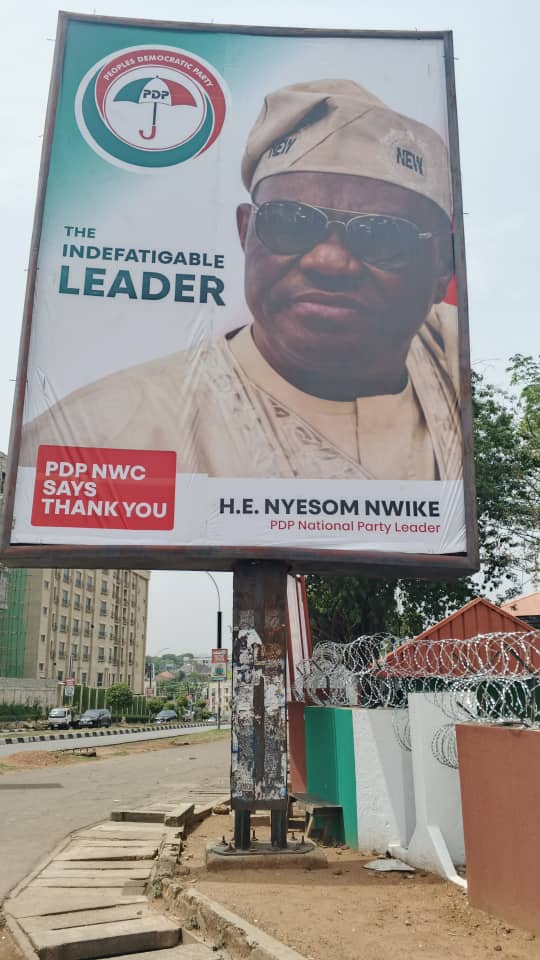
Nyesom Wike and the Anatomy of Power in Nigerian Politics. A Governance Today Nigeria Exclusive Investigative Cover Stor.y
By the Editorial Board | Governance Today Nigeria
Lead Story
In the fluid, often paradoxical theatre of Nigerian politics, few figures command as much fascination—and discomfort—as Nyesom Wike. He is, by every definition, indigestible.
A political enigma who rose through the ranks of the People’s Democratic Party (PDP), fought fiercely to defend it, destabilized it from within, and ultimately found himself wielding significant power under a rival administration led by Bola Ahmed Tinubu of the All Progressives Congress (APC).
This is not merely the story of a man.
It is the story of a system.
PART I: THE MAKING OF A POLITICAL WARLORD
Before the controversy, there was construction of both roads and reputation.
From Obio/Akpor to Government House in Rivers State, Wike built his brand on delivery and dominance. His tenure as governor (2015–2023) transformed him into:
A relentless infrastructure driver
A combative political tactician
A grassroots mobilization machine
His projects spoke loudly bridges, roads, judicial complexes—earning him accolades even from ideological opponents.
Yet, beneath the cement and steel was something more enduring:
control.
In Nigerian politics, projects win applause, but structure wins elections.
Wike mastered both.
PART II: THE FRACTURE — WHEN AMBITION COLLIDES WITH STRUCTURE
The crisis point came in 2022.
The PDP presidential primaries were not just an election, they were a rupture. Wike’s loss to Atiku Abubakar ignited a rebellion that would reshape Nigeria’s political landscape.
Enter the G5 Governors—a bloc of dissenters led by Wike, united by grievance and strategy.
Their demands:
Internal party equity
Leadership restructuring
Power balance between North and South
Their impact:
Deep fractures within PDP
Strategic weakening ahead of the 2023 elections
What emerged was not just dissent, but calculated resistance.
Wike did not leave the party. He outmaneuvered it from within.
PART III: THE PIVOT — A POLITICAL CROSSOVER WITHOUT PRECEDENT
Then came the move that stunned even seasoned observers.
After the 2023 elections, Wike accepted appointment as Minister of the Federal Capital Territory (FCT)—under a government led by his party’s principal rival.
A paradox was born:
PDP strongman
Serving under APC leadership
Retaining influence across both divides
In most democracies, this would trigger immediate expulsion.
In Nigeria, it triggered… accommodation.
THE DEFENCE
Wike’s argument was simple, almost disarming:
“I am working for Nigeria.”
It is a statement that resonates in principle—but unsettles in practice.
Because it raises uncomfortable questions:
Can governance truly be separated from party loyalty?
Is national service above political alignment—or a justification for strategic positioning?
PART IV: THE GOOD — POWER AS PERFORMANCE
To his supporters, Wike represents a rare breed:
- The Executor
He does not theorize governance—he implements it.
As FCT Minister, he has:
Reasserted administrative control
Accelerated infrastructural interventions
Reintroduced a sense of urgency to Abuja’s governance
- The Fearless Operator
Wike speaks with a bluntness uncommon in Nigeria’s carefully coded political language.
He confronts:
Party hierarchies
Federal authorities
Political adversaries
Without apology.
- The Master Strategist
His post-2023 positioning ensured:
Continued relevance
Federal access
National visibility
He lost a presidential ticket—but gained strategic centrality.
PART V: THE BAD — THE COST OF PERSONALIZED POLITICS
But power comes with consequences.
- Party Destabilization
Wike’s rebellion weakened PDP at a critical electoral moment.
The result:
Fragmented opposition
Reduced electoral cohesion
Strategic advantage for rivals
- Institutional Erosion
His actions reinforced a troubling norm:
Individuals are stronger than institutions.
Party discipline, already fragile, became negotiable.
- Normalization of Political Fluidity
Cross-party alignment without accountability risks turning democracy into:
A marketplace of convenience
A system without ideological anchors
PART VI: THE UGLY — WHEN SYSTEMS FAIL
The most disturbing aspect of the Wike phenomenon is not Wike himself.
It is what he reveals.
A SYSTEM WITHOUT IDEOLOGY
The differences between PDP and APC are often:
Strategic
Structural
Not philosophical
A DEMOCRACY OF ELITE NEGOTIATION
Power is not contested—it is negotiated.
Behind the scenes:
Alliances shift
Interests align
Public narratives adjust
A VOTER DISCONNECT
Citizens vote along party lines, yet:
Politicians move freely across them
Mandates become ambiguous
PART VII: THE WIDER HISTORICAL CONTEXT
Nigeria’s Fourth Republic has long struggled with:
Weak party ideology
Frequent defections
Personality-driven politics
Wike is not an exception.
He is the most refined expression of this reality.
PART VIII: LESSONS FOR POLITICAL STUDIES
- Power Is Structural, Not Moral
Control of networks, not rhetoric, determines influence.
- Parties Are Vehicles, Not Ideologies
Political platforms function as:
Access points to power
Not carriers of fixed principles
- Conflict Management Defines Party Survival
The PDP’s inability to manage internal grievances proved costly.
- Adaptability Is Political Currency
Wike’s greatest strength is not loyalty—it is adaptation.
FINAL WORD: THE “WIKE DOCTRINE”
Wike’s career crystallizes a doctrine that may define a generation of Nigerian politics:
“Power is not where you stand—it is where you negotiate your relevance.”
EDITORIAL REFLECTION
Is Nyesom Wike a patriot transcending party lines?
Or a political tactician exploiting systemic weakness?
The answer depends on where one stands.
But one truth is unavoidable:
He has exposed the architecture of Nigerian politics—its strengths, its flaws, and its uncomfortable truths.
CLOSING LINE
In the end, Wike is not just a man to be judged.
He is a phenomenon to be studied.