
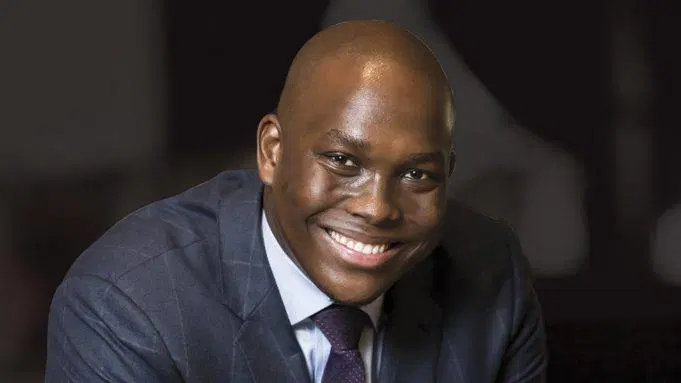
South African entrepreneur and investor Vusi Thembekwayo has rejected the widespread claims portraying South Africans as xenophobic, calling on African nations to focus on economic unity and practical solutions instead of divisive rhetoric.
By Adegboyega Adeleye
South African entrepreneur and investor Vusi Thembekwayo has dismissed the widespread narratives branding South Africans as xenophobic, urging African nations to prioritise economic unity and practical solutions over divisive rhetoric.
Speaking on Friday as a featured guest at The Platform Nigeria 2026, the annual Workers’ Day gathering convened by Poju Oyemade of The Covenant Nation, Thembekwayo framed his remarks within a broader call for continental collaboration and shared prosperity.
The 2026 edition of the event, themed “Unlocking the Second Half Advantage: Transition, Impact and Legacy,” brought together thought leaders, entrepreneurs, and professionals to reflect on Africa’s economic trajectory and the role of innovation in shaping its future. The event commemorates Workers’ Day and aims to inspire a new generation of innovators and nation-builders across the country.
Addressing the often-sensitive issue of xenophobia, Thembekwayo cautioned against the narratives. He acknowledged that while incidents may exist, branding an entire nation with such a label oversimplifies a more complex reality.
The 41-year-old noted: “Contrary to what you see in the media, South Africans are not xenophobic, I am not saying that there are no xenophobic people in South Africa, I am simply saying that to say the entire nation is xenophobic would be missing the point,” further clarifying that his position does not deny the presence of xenophobic individuals but challenges the notion that it defines the country as a whole.
Expanding on this, he pointed to South Africa’s demographic and cultural diversity as evidence of its capacity for coexistence. With a population of over 60 million people and 11 official languages, he described the country as “one of the most diverse societies in the world,” where different groups largely interact and function together.
He further reinforced his argument by highlighting the composition of leadership within South Africa’s corporate landscape. According to him, many of the largest companies in the country are led by executives from across the African continent, reflecting a level of integration that contradicts claims of systemic exclusion.
“If you take a look at the largest companies in South Africa and some of the CEOs of some of the boards of those companies, you will find that the CEOs are many people from the rest of Africa,” he added.
Beyond defending South Africa’s image, the investor shifted focus to what he described as a more pressing concern, which is the risk of Africans being divided by misinformation and amplified tensions.
“I believe there is an agenda to pit us against one another,” he warned, stressing that emotional reactions to isolated incidents only widen existing divisions. Instead, he called for intentional dialogue and stronger cross-border engagement, urging Africans to “reach across the divide” and build genuine understanding.