
GTN INVESTIGATIVE REPORT
Controversial Move Raises Questions on Anti-Corruption Credibility
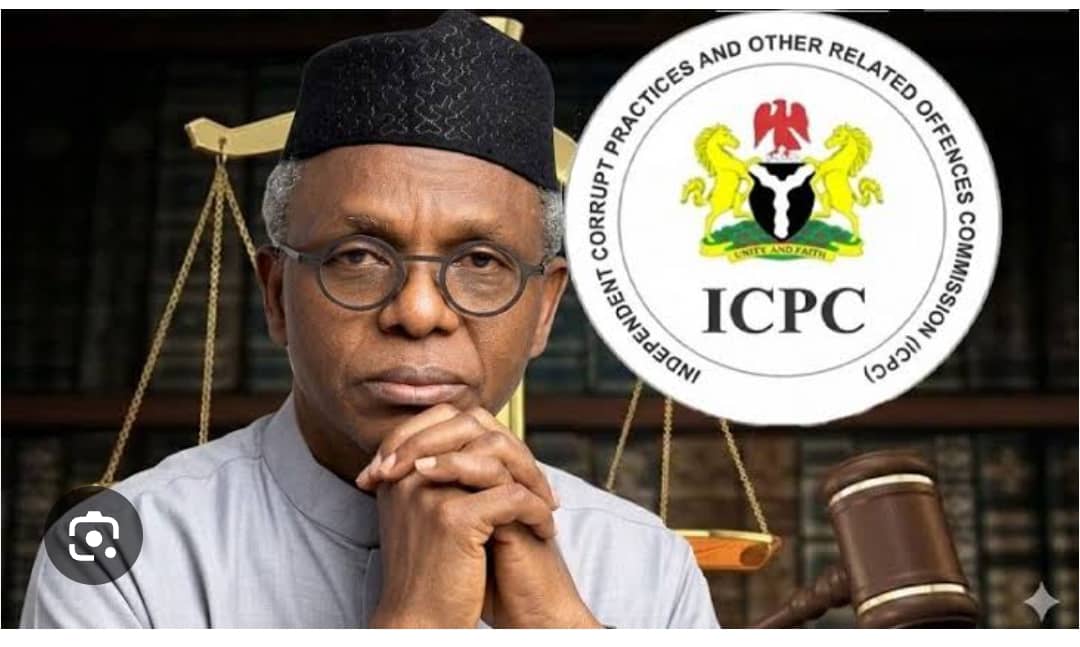
The temporary release of former Kaduna State governor, Nasir El-Rufai, by the Independent Corrupt Practices and Other Related Offences Commission (ICPC) has ignited a fresh wave of legal and public scrutiny, casting a shadow over the integrity of Nigeria’s anti-corruption framework under the administration of Bola Ahmed Tinubu.
El-Rufai, who was standing trial over alleged corruption and money laundering offences, was granted what officials described as “administrative bail” to attend the burial of his late mother, Hajiya Umma El-Rufai, who passed away in Cairo after a brief illness.
While the humanitarian grounds for the decision may evoke sympathy, the legality of the action has become the focal point of intense debate within Nigeria’s legal and civic space.
Legal Questions and Institutional Boundaries
Prominent legal voices, including Inibehe Effiong and Richard Akinola, have raised critical concerns about due process.
At the heart of the controversy lies a fundamental legal question:
Can an anti-corruption agency override a subsisting court remand order without judicial approval?
Legal analysts argue that once a defendant has been remanded by a competent court, only that court possesses the authority to vary or suspend such an order. Any deviation, they warn, risks undermining the rule of law and setting a dangerous precedent.
An internal source within the commission confirmed that the release was granted on “compassionate grounds,” but declined to clarify whether judicial authorization was obtained—further deepening public suspicion.
Historical Precedents: When Compassion Was Denied
What has further fueled outrage is the resurfacing of past cases where individuals in custody were not granted similar concessions, even under deeply emotional circumstances.
A frequently cited example is that of former President Muhammadu Buhari, who, during his military detention in the 1980s following the 1985 Nigerian coup d’état, reportedly was not permitted to attend or participate fully in family mourning rites when his mother passed away. For many Nigerians, this moment has become symbolic of the uncompromising nature of custody under strict legal or military orders.
Beyond Buhari, several other prominent figures have faced similar realities:
Olisa Metuh, during his prolonged trial and detention, repeatedly sought medical and compassionate relief but remained largely bound by strict court directives.
Sambo Dasuki, despite multiple court rulings granting bail, remained in extended detention for years, unable to freely attend to personal and family matters.
Ibrahim Zakzaky, while in custody, faced severe restrictions despite health and humanitarian concerns, with access and movement tightly controlled by state authorities.
These cases—though differing in legal context are now being contrasted sharply with the discretion exercised in El-Rufai’s situation.
Charges and Context
The case against El-Rufai stems from a 10 count charge bordering on alleged unlawful receipt of public funds totaling approximately ₦579 million far exceeding statutory entitlements.
The charges, filed by the Federal Republic of Nigeria, are rooted in provisions of the Money Laundering (Prevention and Prohibition) Act, 2022.
This development follows prior investigations involving the Economic and Financial Crimes Commission (EFCC), as well as indictments by the Kaduna State House of Assembly over alleged financial mismanagement during his tenure.
Perception of Double Standards
For many observers, the issue transcends El-Rufai as an individual and points to a broader concern:
Is Nigeria’s anti-corruption war applied uniformly, or selectively?
Public reactions across social and civic platforms reflect a growing sentiment of distrust. While some Nigerians defend the decision on humanitarian grounds, others see it as a troubling sign of selective justice.
Critics argue that ordinary Nigerians or less politically exposed individuals rarely receive such discretionary leniency, especially without transparent judicial backing. The absence of clear procedural disclosure in this case has fueled perceptions of elite privilege and institutional inconsistency.
The optics, they warn, are deeply damaging.
Implications for Tinubu’s Anti-Corruption Agenda
President Tinubu’s administration has repeatedly affirmed its commitment to fighting corruption. However, incidents such as this risk eroding public confidence.
Anti-corruption efforts, experts note, are not judged solely by policy declarations but by consistency, transparency, and adherence to due process.
Where enforcement appears uneven, the credibility of the entire system is called into question both domestically and internationally.
The Bigger Picture:
This episode underscores a persistent challenge in Nigeria’s governance architecture: balancing humanitarian considerations with strict legal compliance.
While compassion in law enforcement is not inherently problematic, it must operate within clearly defined legal frameworks. Otherwise, it risks being interpreted as arbitrariness—or worse, favoritism.
Conclusion
The ICPC’s handling of this case has opened a critical conversation about institutional accountability and the rule of law in Nigeria.
By drawing comparisons with past high-profile detentions where compassion appeared absent, this development has intensified scrutiny on whether justice in Nigeria is situational or principled.
Without clear answers on the legality of El-Rufai’s temporary release, the controversy may continue to linger serving as a litmus test for the sincerity and coherence of the nation’s anti-corruption drive.
For now, one question remains unresolved: Can justice be seen to be done when its application appears negotiable?