
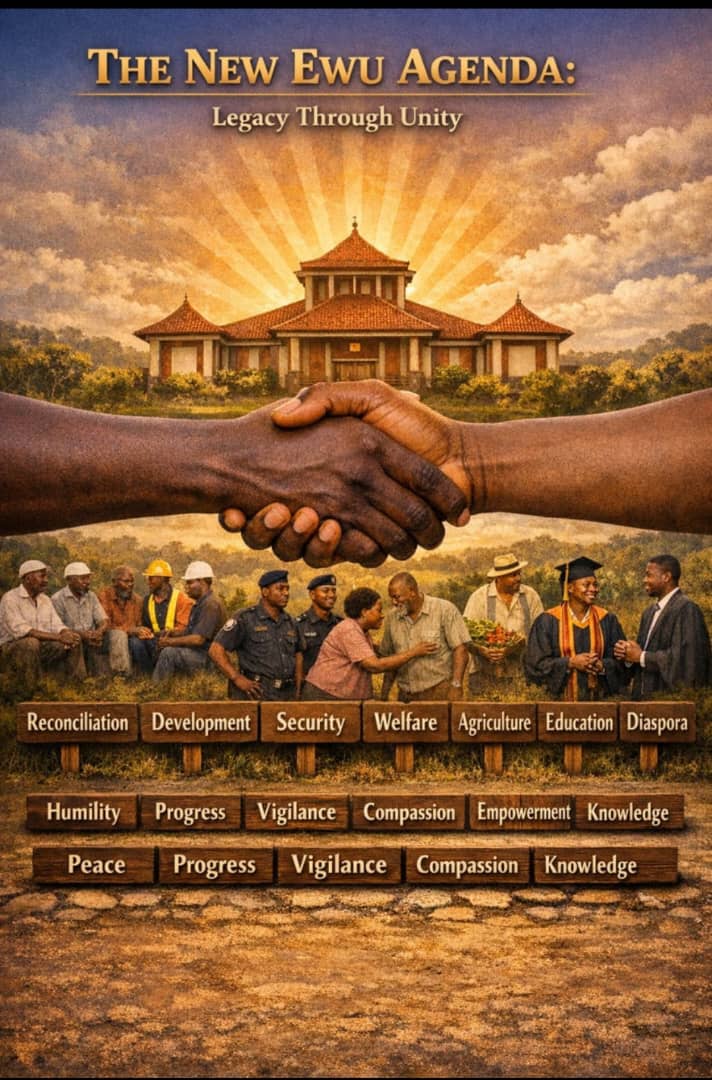
There comes a defining moment in the life of a people when history pauses, destiny calls, and courage must answer. For the sons and daughters of Ewu Kingdom, that moment is now.
The Word of God tells us in 2 Kings 6:24–25 of a city brought to its knees by famine—where scarcity bred despair, division, and desperation. Yet, in 2 Kings 7:1–20, hope broke through. Against all odds, a divine turnaround occurred sudden, undeniable, and transformative. What once seemed impossible became reality within a day.
Ewu Kingdom stands today at such an open doorway of opportunity.
For a quarter of a century, Ewu Kingdom has endured a prolonged season of crisis, division, and stagnation—a metaphorical famine marked by disunity, underdevelopment, and lost opportunities. Grievances have lingered. Swords have remained unsheathed. Trust has been fractured.
But now, under the leadership of His Royal Highness, Jafaru Isesele I, a new chapter beckons—a chapter of hope, unity, and collective progress.
This is a call, not only to leadership, but to every indigene of Ewu: Sheathe your swords. Bury your grievances. Let the brightness of the future outweigh the pains of the past. The Ewu that will shine as a light on the hill to others still in darkness will not be built by blame, but by belief; not by division, but by deliberate unity.
Seven Pillars for a New Ewu Kingdom:
- Peace and Reconciliation: The Foundation of Renewal
No kingdom rises where hearts remain divided. True peace is not merely the absence of conflict, but the presence of justice, forgiveness, and mutual respect. Ewu must embark on a sincere journey of reconciliation—bringing together elders, youths, families, and all factions to heal both old and lingering wounds.
- Development: Building Beyond Today
Critical infrastructure, roads, healthcare, water systems, and digital access—must become priorities, not aspirations. Strategic partnerships with government, private investors, illustrious sons and daughters, and development agencies can unlock Ewu’s vast potential.
- Security: Protecting Ewu Land and People
No society prospers in fear. A coordinated approach to community security—working with vigilante groups, law enforcement, and traditional institutions—is essential. Sons and daughters of Ewu should also be encouraged to participate in formal security structures, including future state policing initiatives, to strengthen local protection.
- Welfare and Finance: Restoring Dignity and Opportunity
Economic empowerment must take center stage through skills acquisition, small business support, cooperative societies, and access to microfinance. Welfare systems must prioritize the vulnerable—the widows, the elderly, and disadvantaged youths. An Ewu Community Endowment Fund should be established to ensure sustainable, independent funding.
- Agricultural Renewal: From Subsistence to Enterprise
Ewu’s soil is rich, and its people are capable. Agriculture must be repositioned as a viable enterprise. This requires securing farmlands and forests, empowering local farmers, and discouraging exploitative land-use arrangements that disadvantage indigenous landowners.
- Education and Human Capacity Development: Investing in Tomorrow
Scholarships, mentorship programs, vocational training, and institutional partnerships must be prioritized. Education must be both formal and practical, equipping Ewu youths not only to seek jobs, but to create them, and to thrive in a rapidly evolving digital world driven by artificial intelligence.
- Diaspora Engagement: Bridging Home and Abroad
The Ewu diaspora represents a reservoir of knowledge, influence, and resources. Structured engagement frameworks can channel this strength back home for sustainable development.
Resolution Charter: The Path Forward
The pressing question remains: how will Ewu heal from 25 years of division and fragmentation?
The answer lies in example.
The life of Late Chief Joseph Osemunu Omosun, MBE, reminds us that true greatness is not found in titles or vindication, but in the courage to choose peace over rivalry and community over self. Faced with contention over the Onojieship of Ewu Kingdom, he laid down personal ambition and embraced reconciliation, accepting the title of Ezomo of Ewu as a symbol of unity rather than defeat.
His choice preserved the future.
And we must ask: had he chosen differently, what would have been the fate of Ewu?
His example must now serve as a guiding light, inspiring all sons and daughters of Ewu to rally around HRH Jafaru Isesele I as the Onojie of Ewu.
Let these principles guide us:
Community cohesion is greater than conquest.
Reconciliation is stronger than rivalry.
Legacy is built not by winning disputes, but by healing divisions.
For HRH Jafaru Isesele I, tempered by 25 years of resilience, patience, sacrifice, and perseverance, these are not just ideals, but lived values. They are the very qualities required to drive and actualize the New Ewu Agenda with the support of the people.
The long season of crisis has come to an end, affirmed by the 2024 judgment of the Supreme Court of Nigeria. And just as no one drives forward while fixed on the rearview mirror, Ewu must now look ahead with purpose.
Ahead lies a new reign. Ahead lies renewal.
A leader shaped by history. A people ready for transformation. A kingdom poised for peace and progress.
Just as Chief Omosun’s restraint elevated his honor, so too will the collective restraint of all elevate Ewu Kingdom in this new era.
Let this be our covenant: To build, not to break.
To reconcile, not to resent.
To leave behind a legacy of unity, dignity, and progress for generations yet unborn.
Content developed and analyzed by:
Barr. Okhuelegbe Kingsley Omose
Legal Practitioner | Researcher (Value Extraction) | Public Affairs Analyst